

Note: Copy Trading supports Polymarket and Predict.fun. Regional restrictions apply.
Quickstart
- Open
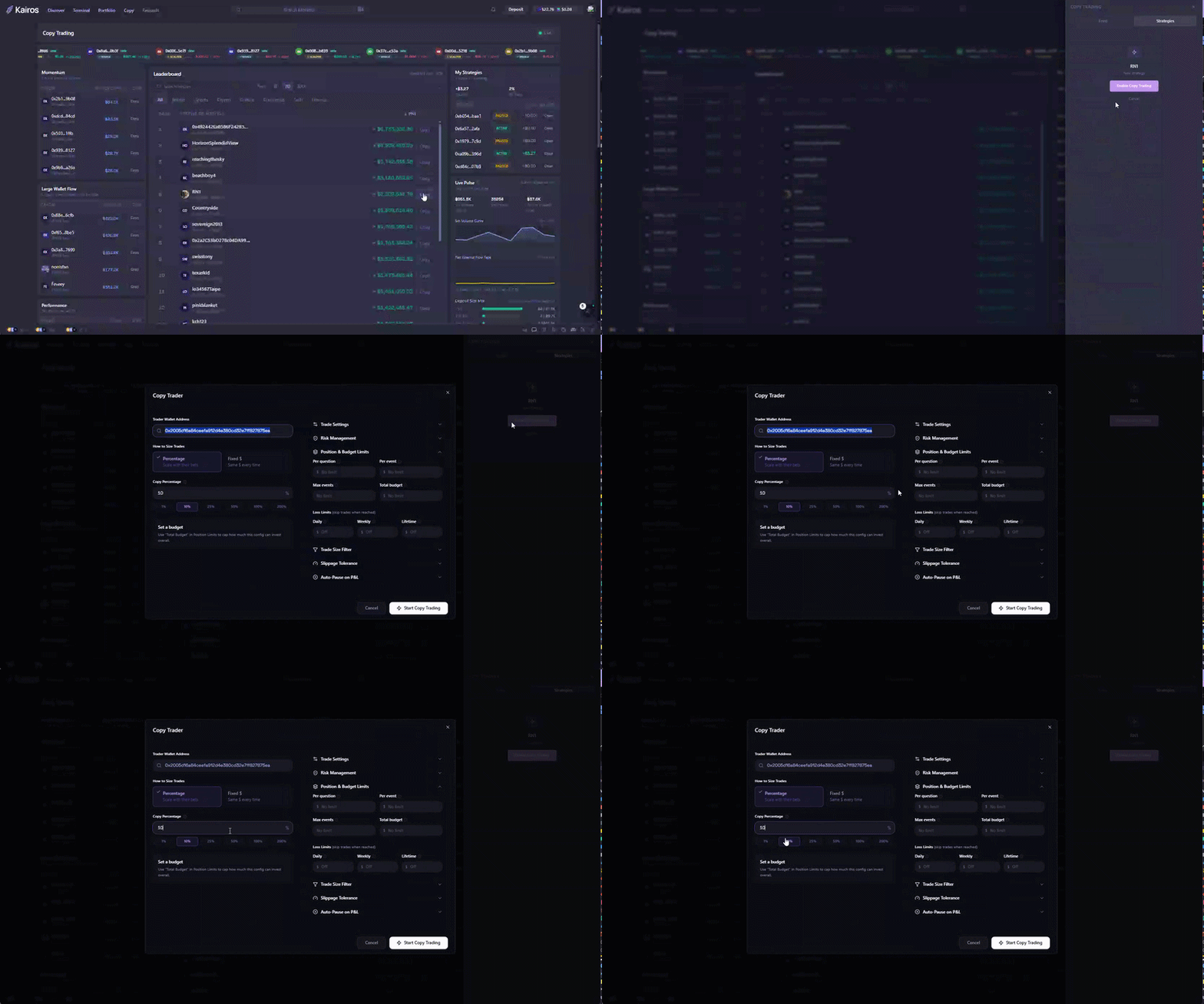
/copytrading— the leaderboard loads automatically, ranked by realized PnL. - Set the time period to 30d and pick a trader near the top with a healthy follower count.
- Open their profile and select Copy. The strategy configurator opens.
- Set Allocation type: Percentage, value: 10% (or lower), leave everything else at default.
- Confirm to start copying.
How It Works
Kairos watches tracked traders on-chain. When a trader you subscribe to trades, Kairos:- Detects the trade off the live Kairos trade tape (usually within seconds).
- Evaluates it against your allocation, filters, and risk controls.
- Copies it — if all checks pass — by submitting a matching order.
- Records the result on Activity as
PENDING,QUEUED,EXECUTING,EXECUTED,FAILED, orSKIPPED.
Three detection paths
The live tape’s upstream ingest includes a mempool feed, but that is one source
among several and is not how copy trading itself detects a trade — two of the
three paths above read confirmed data.
Signals older than 30 seconds are dropped before any record is created. If
a leader trades and nothing at all appears on Activity — not even a Skipped
row — that is the staleness cut-off, not a bug. Entries older than 120 seconds
are rejected further downstream.
Finding a Trader
The leaderboard at/copytrading is the primary discovery tool.
The leaderboard ranks by realized PnL for the selected period.
Each entry shows a lifetime win rate (winning closed positions ÷ total closed positions). It only appears once a trader has at least 10 closed positions with recorded outcomes, and only on venues that report lifetime win/loss counts — Polymarket and Predict.fun. On the All board, the count is summed across both venues. Until the threshold is met the field is absent rather than
0.
A wallet subscription copies Polymarket and Predict.fun trades. Orders
execute on the same venue as the leader’s trade, using your wallet and balance
on that venue. Your subscription budget and loss limits cover both venues;
per-market limits apply separately to each venue’s market.
- Consistency across 1d/7d/30d beats a single hot day.
- Volume, not just PnL — 100k volume beats 50.
- Verified badge — confirmed identity and track record (a signal, not a requirement).
- Other badges — traders can also carry On Fire, Whale, Sharpshooter, or Bot. A Bot badge is worth knowing about before you mirror the flow.
- Follower count — a tiebreaker; zero followers on an established trader is unusual.
- Recent activity — check the trader’s recent trades; a dormant trader generates nothing to copy.
- PnL chart shape — a steady slope is safer than a spiky recent pump.
Follow vs. Copy
Upgrading Follow → Copy is atomic — no overlapping subscriptions or gaps.
Configuring a Subscription
Open the strategy configurator from a trader profile’s Copy action. The same settings are available later from My Strategies → Settings.Allocation
The dialog offers two allocation types.
Fixed USD across all your active subscriptions caps at $100,000 combined.
Separately, a per-user total open exposure cap applies across copy trading
as a whole.
100% Percentage only works if your wallet is at least as big as the
leader’s. Otherwise the copy order fails on balance — and an insufficient
balance auto-pauses every subscription you have, not just the one that
failed. Use Fixed USD to track a whale instead.
PROPORTIONAL allocation type exists in the API but is not offered in
the dialog and has different semantics from a share ratio. Treat it as
unsupported.
Execution Mode
Most copy traders should stay on Market — Limit looks safer but misses fills in fast markets; pair Market with Max Slippage instead.
Limit mode skips the slippage check entirely. It uses the leader’s signal
price as the limit, so Max Slippage only does anything on Market.
Collateral Mode
collateral_mode is an API-level subscription setting, not a toggle in the
Copy Trader dialog. It is stamped onto every follower order the subscription
emits, so it is where you say whether copy orders may check — or move — your
collateral before they reach the venue.
fund requires both caps, and neither is accepted under any other mode:
The default is
skip, so an existing subscription is unaffected and a follower
funds nothing they did not opt into. An unrecognised mode is rejected with
collateral_mode must be one of: skip, check, fund; fund without a cap is
rejected with collateral_mode 'fund' requires collateral_max_bridge_fee_usdc
(or ..._max_funding_wait_ms); a cap under any other mode is rejected with
collateral_max_bridge_fee_usdc is only valid with collateral_mode 'fund'.
Follow Exits and Auto Redemptions
- Follow Exits (default on) — closes your copy when the leader sells. Off leaves you to manage exits yourself.
- Auto Redemptions (default on) — redeems winning positions to USDC on resolution, swept on an interval. Off leaves them sitting until you redeem manually. This is an API-level setting; it is not a toggle in the Copy Trader dialog.
Filters
A trade failing any active filter is Skipped with a reason on the Activity tab.Max Slippage is not optional in practice. Leave it blank and a 5% service default applies — there is no “unlimited slippage” setting.
Max Time to Resolution fails closed. If the market’s end date cannot be resolved, the trade is skipped rather than copied.Three independent size caps, stackable:
If you only set one, use Max Position Size — it is the ceiling on everything
this subscription can have at risk at once.
The position and per-market caps are indistinguishable in Activity. When
either binds, the skip reason is the same generic “Allocation capacity
exhausted”.
Risk Controls (Advanced)
Every risk control pauses the subscription. None of them sells, closes, or
liquidates anything. Tripping a Stop Loss stops new copies — your existing
positions stay open and you must flatten them yourself. Every trigger message
begins “Auto-paused: …”.
- Stop Loss — a percentage loss threshold (0–100); breaching it pauses the subscription.
- Take Profit — the same on the upside; hitting it pauses the subscription.
- Trailing Stop — a percentage retrace from the subscription’s peak PnL high-water mark; breaching it pauses.
- Loss Limits — USD caps on cumulative loss, tracked Daily (trailing 24h), Weekly (trailing 7d), and Lifetime. Breaching any pauses.
- Auto-Pause on PnL — a USD floor, not a percentage: pauses when total PnL falls below it.
- Max Events — a trade-count budget (“copy the next 25 trades”); pauses once exhausted.
They are computed from realized PnL only. There is no mark-price input, so unrealized PnL is treated as zero. A position deep underwater but unsold will not trip Stop Loss, Take Profit, or Trailing Stop.
They are configured through the API, not the Copy Trader dialog. The dialog exposes loss limits and Max Events; Stop Loss, Take Profit, Trailing Stop, and Auto-Pause on PnL are subscription fields set via the API.If the trailing high-water mark cannot be read, the subscription pauses rather than continuing without the guard.
Recommended Presets
Start Conservative for your first trader; upgrade once you’ve seen a full week of activity, including skips and failures.
My Strategies
Open My Strategies from/copytrading to manage every subscription. The
page shows status, sizing, PnL, copied trades, fill rate, and recent activity.
Pause and Resume are available directly on each row.
Open a strategy for its detailed views:
- Overview — exposure, positions, performance, and recent activity.
- Trades — copied orders and their execution or skip reason.
- Trader Feed — the source trader’s recent activity.
- Settings — allocation, execution, filters, and risk controls.
- Health — failure and skip rates with reason breakdowns.
Subscription Lifecycle
Pausing or cancelling never exits existing positions — it only stops new copies. Flatten manually from Portfolio.
Cancelling does cancel your resting copy orders, so no further fills arrive from orders already on the book. Pausing does not — a resting copy order placed before you paused can still fill.You can hold at most one active subscription per trader.
Skip Reasons
The common ones:
Two things that are not skips:
- Insufficient balance is a
FAILEDintent, not a Skip — and it pauses every subscription you have, with the reason “Insufficient balance — add funds and resume when ready.” - Signals older than 30 seconds produce no Activity row at all. They are dropped before an intent is created.
Limits and Fees
The rate limit is a single bucket covering create, update, pause, resume,
cancel, and bulk actions together — not a separate allowance per action.
Copy Trading carries no copy-trading surcharge and no profit share to the
leader. Copy orders go through the normal execution path, so the standard
Kairos fee tier and the source venue’s exchange fees apply as they would to
an order you placed yourself — see Fees. Market mode (the
default) is taker flow.
Troubleshooting & FAQ
- Nothing is being copied. Check the trader’s recent trades, then the Activity feed for skip reasons (blocked markets and slippage are the common ones), then your USDC balance. If there are no Activity rows at all, the leader’s signals may be arriving past the 30-second staleness cut-off.
- Subscription auto-paused. Check the pause reason — usually a loss limit, a risk control, Max Events exhausted, or an insufficient balance (which pauses all your subscriptions).
- An order failed with an exchange error. Kairos does retry transient failures: rate limits are retried up to 3 times, an unavailable order book up to 3 times with a 15-second delay, and price lookups up to 3 times. An intent stuck mid-execution is requeued. Only after those are exhausted is the intent marked
FAILED— and a terminally failed intent is not resubmitted. - Cancelled by mistake. Cancel is permanent; create a new subscription. Activity history is preserved for auditing.
- Can I copy a market the leader hasn’t traded yet? No — Copy Trading only mirrors orders that actually happen.
- Does the leader know I’m copying them? They see a follower count, not follower identities.
- Sports and crypto markets? Supported for eligible leader trades on Polymarket and Predict.fun. Scope it with the Allowed / Blocked Markets lists — note these take market token ids; there is no per-category filter on a subscription. The leaderboard’s category control is a discovery filter only.