

What Is an Order Book?
An order book is a live list of everyone who wants to buy and everyone who wants to sell. Think of it like an auction house — buyers shout out what they’re willing to pay, and sellers shout out what they’re willing to accept.Bids and Asks
There are two sides to every order book:
The best bid is the highest price any buyer is willing to pay.
The best ask is the lowest price any seller is willing to accept.
The Spread
The spread is the gap between the best bid and the best ask.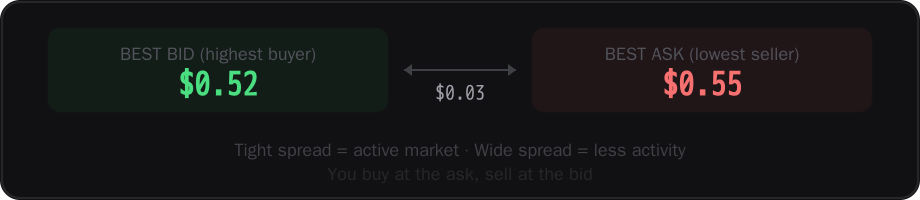
Reading the Order Book
Here’s what a simple order book looks like: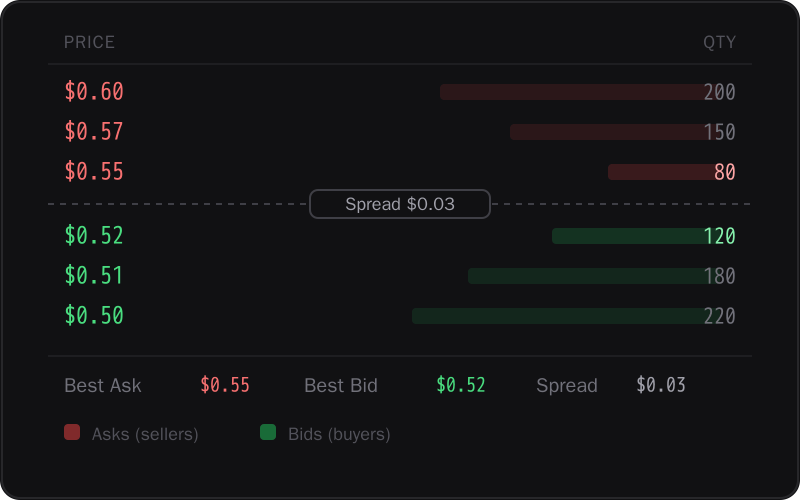
- The cheapest you can buy right now is $0.55 (80 shares available)
- The most you can sell for right now is $0.52 (someone wants 120 shares)
- The spread is $0.03
Depth — How Much Is Available
The numbers next to each price are the quantity — how many shares are sitting at that price. This is also called depth or liquidity. More depth = easier to trade large amounts without moving the price. If you want to buy 300 shares and only 80 are available at 0.57, $0.58). This is called walking the book — more on that in the execution chapter.Why It Matters
The order book tells you:- What price you’ll get — look at the best bid/ask
- How much you can trade — look at the depth
- How active the market is — look at the spread
- Where support/resistance sits — large quantities at certain prices
Think of It Like a Farmer’s Market
Imagine you’re at a farmer’s market buying apples:- Several sellers have signs showing their prices
- The cheapest seller has apples at $0.55 each, but only 80 left
- The next cheapest has them at $0.57
- Meanwhile, other buyers are offering to buy at $0.52